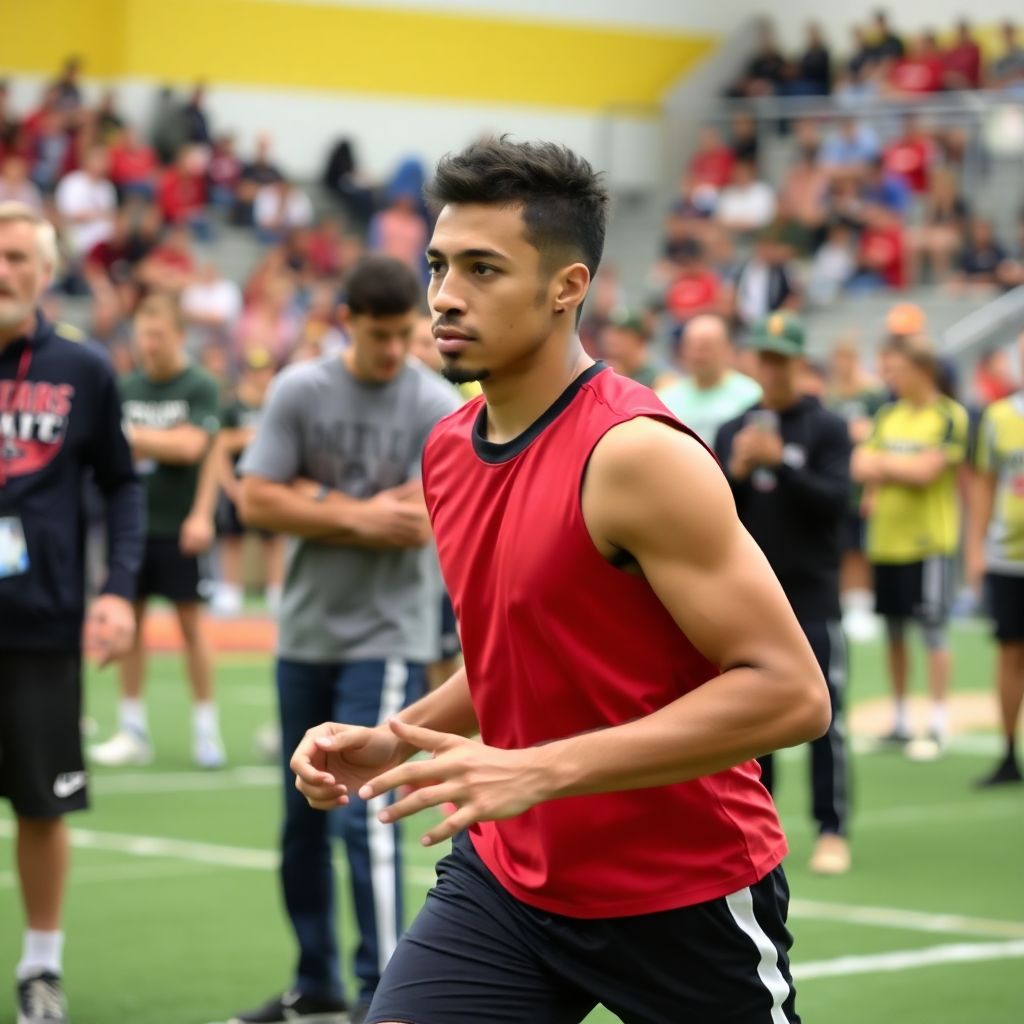
Sports events and tryouts are powerful showcases if you arrive prepared: clear role, safe physical base, simple tactical plan, and evidence (video, stats, contacts) ready to send the same day. Focus on consistent decisions, work rate, and attitude: that is what scouts remember, not one random play.
Essentials to Catch a Scout’s Eye
- Know precisely what role you will play and which 2-3 strengths you want to show.
- Arrive with safe, progressive preparação física e mental para peneiras esportivas, not after a sudden training spike.
- Play simple, fast, and reliable before you try risky “highlight” actions.
- Use each event to collect video and basic stats for a compact evidence pack.
- Follow up the same day with polite messages, links, and updated contacts.
- Choose treinamento intensivo para jovens talentos do esporte that fits your age, schedule, and recovery capacity.
How Scouts Evaluate Young Players at Events
Events and peneiras are useful when you already play regularly in a club or school team and your body is adapted to current training. They are less effective if you are returning from injury, out of shape, or have not played full matches for weeks.
To understand como ser observado por olheiros no futebol or in other sports, think in four blocks scouts usually watch:
- Game understanding: positioning, reaction to transitions, reading of space and opponents.
- Technical execution: clean first touch, passes at the right speed, control under pressure.
- Physical profile: movement quality, coordination, acceleration, ability to repeat high efforts safely.
- Psychological and social traits: body language, response to mistakes, interaction with teammates and staff.
Events are not ideal when you:
- Use them as your first match after a long rest or injury break.
- Depend on them to “save” a season without consistent training behind you.
- Feel pressured to play through pain instead of respecting medical advice.
Micro-routine to apply: Before the event, write on a small card: your position, 3 simple strengths (e.g., “first touch, pressing, short passing”), and 1 behavior goal (e.g., “encourage teammates”). Review it in the locker room and at halftime.
Physical and Technical Prep for Peak Showcase Performance
Preparation for events in Brazil must be safe, progressive, and compatible with school and club demands. Avoid last-minute marathons or random workouts from the internet. Instead, organize what you need weeks in advance.
Safe preparation checklist
- Medical and injury status: clearance from a doctor or physio if you had recent injuries; know what movements you must avoid.
- Training structure: a mix of team practices, individual technical work, and light strength/coordination sessions.
- Recovery tools: good sleep routine, hydration, simple stretching and mobility you can do at home.
- Sport-specific equipment: appropriate footwear for the surface, spare socks, tape or bandages if recommended, water bottle.
Building the right workloads
- Increase your weekly volume gradually across 2-3 weeks instead of doubling sessions in a few days.
- Keep one lighter day before matches and events, focused on short, sharp touches and set pieces.
- Use treinamento intensivo para jovens talentos do esporte only if it includes supervision, structured rest days, and monitoring of how you feel.
Technical focus points
- Master first touch in tight spaces (walls, cones, or a friend as pressure).
- Practice passing and finishing with both feet from realistic positions you use in games.
- Repeat your most common tactical actions: fullbacks crossing on the run, forwards finishing 1v1, midfielders switching play, etc.
Micro-drill: 10-15 minutes, 3-4 times per week: wall passes (one-touch and two-touch) with each foot, then quick changes of direction over 5-10 meters. Keep the intensity moderate and focus on clean technique.
Mental Resilience: Staying Composed When Under Scrutiny
Mental preparation is what keeps your physical and technical work visible when nerves hit. Use the following step-by-step process in the weeks before, then simplify it for event day.
-
Define your controllable goals
Replace “I must impress scouts” with 2-3 simple, controllable targets such as “quick defensive transition” or “strong communication”. This applies both to como ser observado por olheiros no futebol and to other sports.
- One goal for decision-making (e.g., “play forward when possible”).
- One for effort (e.g., “sprint back after every loss of possession”).
- One for attitude (e.g., “neutral body language after mistakes”).
-
Practice calm breathing under light stress
Use safe breathing routines to manage activation, never extreme methods. The idea is to calm, not to hyperventilate.
- Inhale through the nose for about 4 seconds, exhale through the mouth for about 6 seconds.
- Repeat for 6-8 breaths during warm-up breaks or while tying your boots.
- Stop if you feel dizzy; breathing should feel comfortable.
-
Rehearse your first actions of the match
Visualize and practice the first 3-5 actions you want: a safe pass, a simple control, a basic defensive action.
- Do light ball work imagining match speed but without full contact.
- Focus on what you see, feel, and hear in a real game situation.
-
Build a reset routine after mistakes
Scouts notice how quickly you recover from errors. A clear reset helps you avoid panic.
- Step 1: one deep breath while looking away from the crowd or bench.
- Step 2: short cue word (“next”, “focus”, “simple”).
- Step 3: eye contact or quick signal to a teammate, then move into the next position.
-
Use supportive self-talk, not fantasy
Repeat realistic, process-focused phrases instead of “I can’t fail” or “I must be the best”.
- Examples: “one play at a time”, “strong first touch”, “eyes up before pass”.
- Write 3 phrases inside your notebook or phone and read them on the way to the event.
Fast-Track Routine for Event Days
- Arrive early, do 6-8 calm breaths, then 5 minutes of easy ball touches.
- Repeat your 3 controllable goals and 3 self-talk phrases while changing.
- Visualize your first safe action, then execute it in the first minutes.
- After any mistake, apply your 3-step reset (breath, cue word, move again).
Micro-drill: Before bed on the three nights before the event, close your eyes for 3 minutes and replay a full attack or defense sequence where you stay calm and make a solid, simple decision.
Tactical Showcase: Choosing Moments to Stand Out
Scouts want to see if your game intelligence fits higher levels. Use this checklist after each event to judge if you showed your best decisions, not just isolated skills.
- I played my natural position or a role I know, instead of chasing the ball everywhere.
- I stayed connected to team organization (pressing lines, defensive block, or transition plans) instead of improvising all the time.
- I chose simple options in the first minutes to “enter” the game before trying risky plays.
- I created or prevented chances in the zones that match my role (e.g., winger attacking 1v1, defender winning duels, setter running the offense).
- I adjusted my style to the opponent: when they pressed high, I used fewer touches; when they dropped deep, I tried more creative actions.
- I communicated clearly (pointing, calling, short instructions) without shouting at teammates.
- I protected the ball and my body in duels instead of going into reckless challenges.
- In decisive moments (corners, free-kicks, final minutes), I knew exactly my task and executed it.
- My work rate without the ball matched or exceeded my work rate with the ball.
Micro-drill: Watch one recent game of yours. Pause 5 times when you are on screen and ask: “What was the simple, smart option here?” Write those 5 situations and rehearse them in your next training.
Creating a Compact Evidence Pack: Video, Stats and Highlights
Events are short. To keep scouts interested, you need an organized, honest record of your performances. Many young players lose opportunities because of basic, avoidable mistakes.
Frequent mistakes when building your portfolio
- Only collecting “nice goals” clips: ignoring defensive work, pressing, combination play, or off-the-ball movement.
- Posting raw, shaky videos: no clear view, no indication of who you are on the pitch or court.
- Hiding weaknesses: sending only one perfect game instead of 2-3 normal matches that show your real consistency.
- Over-editing with music and effects: scouts prefer clear, simple footage with time and opponent information.
- Lack of context: no description of competition level, your age, and your position.
- Inflated “stats”: counting friendly games with very low level as if they were official competitions.
- No backup or links: videos only on one phone, or on social media with privacy settings that block scouts.
- Ignoring education: not mentioning your school situation, even if you are interested in como conseguir bolsa esportiva em clubes e academias or in international programs.
Minimum content for an evidence pack:
- Short highlight video (3-5 minutes) showing different actions: with and without ball, under pressure, transitions.
- One full game or extended footage where the scout can follow you continuously.
- Simple profile: name, date of birth, height, main and secondary positions, dominant foot or side, current team and competition.
- Contact data for you and a coach, plus a brief note on your availability for trials or scholarships.
Micro-drill: After the next match, select 5 actions you are proud of and 2 you want to improve. Cut those 7 clips and save them in a separate folder with the match date and competition name.
Converting Attention into Trials, Contacts and Contracts
Being seen is only the beginning. You have to transform interest into safe, realistic opportunities for growth. This is particularly important if you seek como conseguir bolsa esportiva em clubes e academias or school-club partnerships in Brazil.
Alternative ways to open doors
-
Structured online learning and support
Look for a serious curso online para jovens atletas se destacarem em competições that covers not only drills but also planning, communication with clubs, and portfolio building. Use it to complement, not replace, your team training.
-
Regional school and university competitions
Many coaches and coordinators monitor school championships. Perform well there, organize your videos, and ask your PE teacher or coach to introduce you to interested programs.
-
Local clubs and academies with development focus
Before paying for any program, check if they have clear paths for trials, links with professional clubs, or educational agreements. Ask directly how they support athletes aiming for scholarships and study-sport balance.
-
Multi-sport skill development
If high-level competition in your main sport is not accessible right now, use other sports or physical activities to develop coordination, endurance, and decision-making while you keep searching for events.
Micro-drill: Create a simple “opportunity map”: list 3-5 clubs, schools, or academies near you, write who to contact, what they offer (competitions, scholarships, support), and what material (video, profile) you must send first.
Answers to Common Concerns from Aspiring Players
How far in advance should I start preparing for a showcase or tryout event?
Ideally, you maintain regular training year-round and only adjust intensity 3-4 weeks before the event. If you are starting from zero, use the first weeks to build general conditioning safely, then add sport-specific intensity under a coach’s supervision.
Is one big event enough to be discovered by scouts?
Usually not. Scouts prefer to see consistency over multiple games or tournaments. Treat every school match, friendly, and small competition as part of your long-term showcase instead of waiting for one magical event.
What if I feel very nervous and play worse when I know scouts are watching?
That is normal. Focus on your controllable goals, breathing routine, and a safe first action in the game. Over time, repeating this process reduces anxiety and lets your true level appear in important matches.
How can my family help without adding extra pressure?
They can help with organization (transport, food, documents) and by supporting your routines and rest. It is more useful to ask “How can I support you?” than to give constant technical instructions from the stands.
Do I need expensive private training to impress scouts?
No. Quality team training, simple individual work, and good recovery can be enough. Extra coaching helps when it is structured, safe, and coordinated with your main coach, but it is not a magic shortcut on its own.
How important are school grades if I am focused on sport?
They are very important, especially for scholarship routes. Many clubs, academies, and schools prefer or require athletes who can manage study and training together, so keep your academic habits strong alongside your sport.
What should I do after an event where I think I played badly?
First, recover physically and emotionally. Then review video if possible, identify 2-3 specific points to improve, and adjust your training. Use the experience to refine your preparation instead of treating it as a final verdict on your potential.